Trend or long-term design decision?
Interior trends are useful when they help us notice a change in how people want to live. They become a problem when every new finish is treated as a requirement. A home should not look dated because a social-media trend changes next year.
Recent Hyderabad design coverage points toward warmer minimalism, natural materials, smart-home integration, artisanal details and biophilic spaces. Current Hyderabad interiors coverage reflects this broader shift. The more important question is which ideas deserve to become part of the architecture of a home.
1. Warm minimalism is replacing cold minimalism
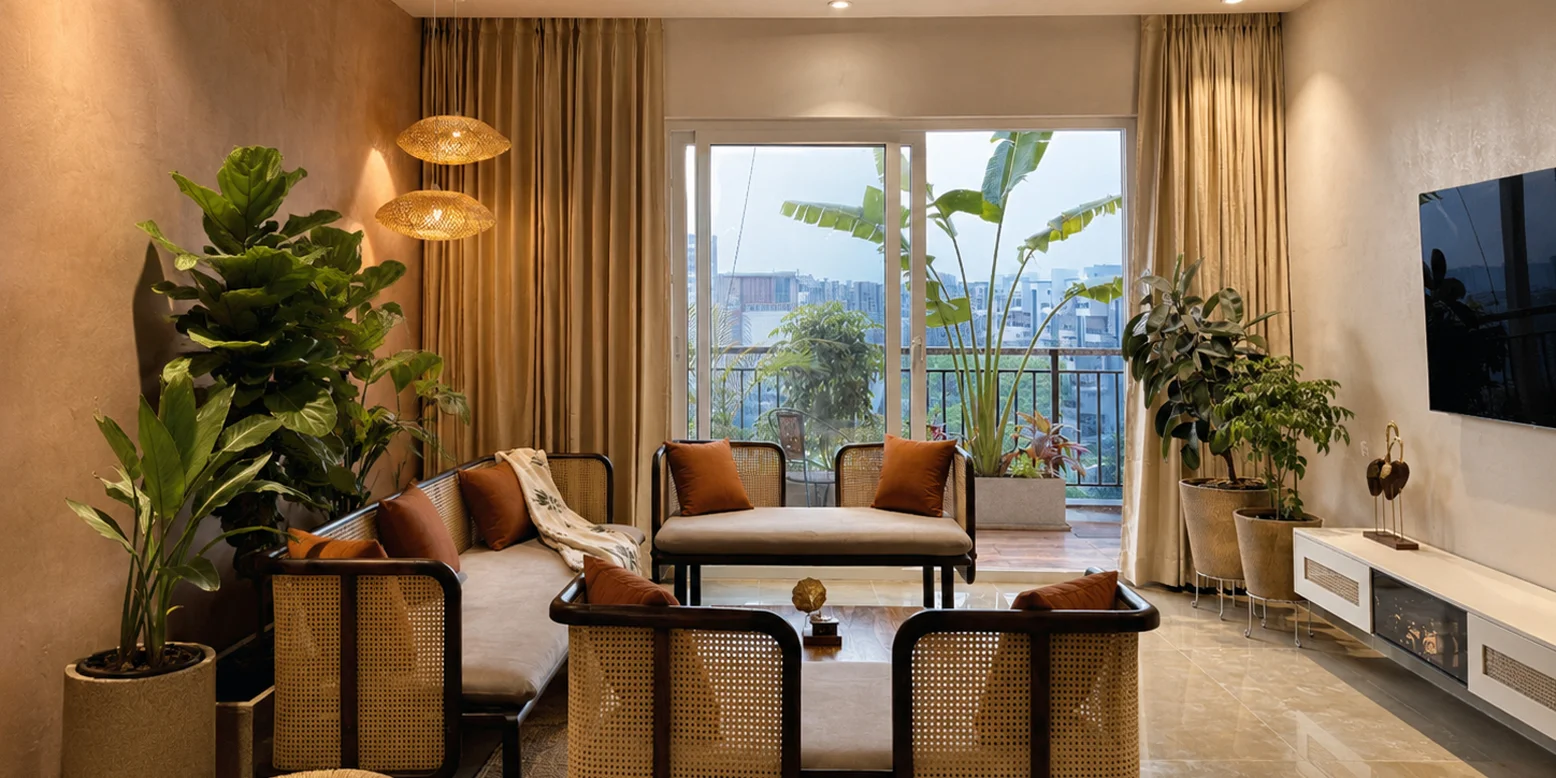
Minimalism is not disappearing; it is becoming more comfortable. Instead of stark white surfaces and visually empty rooms, contemporary homes are using warm neutrals, timber tones, stone, textured plaster, soft fabrics and carefully selected objects.
The principle is simple: reduce visual noise without reducing personality. This works particularly well when the architecture provides strong proportions and the interior palette is allowed to remain restrained.
2. Natural materials are becoming the visual language
Wood, stone, lime-based finishes, woven materials and tactile textiles bring variation without requiring a crowded room. They also create a stronger connection between interior and landscape.
For Hyderabad homes, material selection should consider more than appearance. Maintenance, heat, moisture, durability, availability, workmanship and the way a surface changes over time all matter. A material that looks beautiful in a sample can behave very differently at full scale.
3. Curves work best when they solve a spatial problem
Curved walls, rounded furniture and softened joinery are increasingly visible in contemporary interiors. The strongest applications are not curves for the sake of curves. A radius can improve circulation, soften a transition, frame a view or make a large volume feel more intimate.
Use curves selectively. One well-resolved architectural gesture can have more impact than repeating a shape across every room.
4. Lighting is becoming more architectural
Layered lighting is one of the most practical upgrades a home can make. Ambient light provides general illumination; task lighting supports activities; accent lighting highlights art, materials or landscape.
Concealed sources and carefully positioned fixtures can help architecture remain visually quiet. More importantly, lighting should be planned alongside ceilings, joinery, electrical points and furniture rather than added at the end.
5. Storage is becoming part of the architecture
Beautiful interiors usually depend on disciplined storage. Full-height joinery, integrated utility zones, concealed appliances and purpose-built cabinetry can keep everyday objects available without allowing them to dominate the room.
This is especially valuable in apartments, where every square metre has to work hard. Good storage is not merely an interior finish; it is part of spatial planning.
6. Biophilic interiors are moving beyond houseplants
Bringing nature into a home can mean more than adding pots. Views to planting, courtyards, natural textures, daylight, water-sensitive landscape and operable openings can all create stronger relationships between interior and exterior.
The aim is not to decorate a room with greenery. It is to make nature part of the experience of the space.
7. Craft and local character matter more than “luxury” labels
Personal interiors are increasingly built around objects, finishes and details that have meaning. Handcrafted elements, Indian textiles, stonework, timber detailing or commissioned pieces can give a home identity that a catalogue package cannot.
This is also where restraint matters. A few well-chosen pieces can carry more character than filling every surface.
8. Smart technology should disappear into the design
Home automation is useful when it makes everyday life easier without making the interior look like a control room. Lighting scenes, climate control, security, shading and entertainment can be coordinated discreetly.
The best smart-home design begins with user routines. Technology should support how residents actually live, not create a list of features that are rarely used.
What should you actually choose for a Hyderabad home?
- Choose a warm, durable base palette that can accept future changes.
- Invest in lighting design rather than decorative fixtures alone.
- Use natural materials where their performance and maintenance make sense.
- Build storage into the architecture from the beginning.
- Use curves and statement details selectively.
- Connect interiors to daylight, planting and views wherever the site allows.
- Spend on craftsmanship and proportion before chasing short-lived finishes.
The 80/20 rule for timeless interiors
A useful approach is to let the permanent elements—planning, flooring, cabinetry proportions, lighting infrastructure and major surfaces—remain relatively timeless. Trends can then appear in art, movable furniture, textiles and accessories that are easier to change.
The result is an interior that feels current in 2026 without being trapped in 2026.